Intel Launches Cheaper Intel Quad-core While AMD Still Looks Dumbfounded

launch.jpgIn addition to their mobile Extreme CPU, Intel has also announced its 3.0GHz Core 2 Extreme processor, the 65-nm QX6850 with four cores and dual 4MB Level 2 cache. The QX6850, touted as the fastest consumer processor now available, is the flagship of their new 1,333MHz Front Side Bus CPU family, which includes the Core 2 Duo E6850, E6750 and E6550, all of them with cheaper prices than the previous generation.

Intel launches six-core Xeon 7400, your bank account shudders

Intel launches six-core Xeon 7400
Thanks to Google's Chrome and Microsoft's IE8, discrete processes are the new hotness, and more apps running simultaneously on your desktop is a great excuse to buy a CPU with more cores! On cue, Intel has officially launched its new Xeon 7400 processor, hitting 2.6 GHz on six cores and boasting an advertised 43 percent jump in performance over the lowly quad-core 7300, which had only half the 7400's 16MB of L3 cache. Impressive stuff, especially considering a bonus 10 percent drop in power consumption, but at $2729 for the top of the line model it's not exactly consumer-oriented. Perhaps Intel could interest you in a nice Core i7?

Intel reveals some More Nehalem information at recent presentation

Yep, you guessed it. Another Nehalem article to satisfy your undying needs. ;)

*the new info is in the second half of the overview*

Intel reveals some more Nehalem information at recent Core i7 presentation

Source: http://www.overclock3d.net/news.php?/cpu_mainboard/intel_core_i7_presentation/1
Something new that Intel is bringing to us with this modular design, shown on the slide to the right, is the "uncore". In short, everything other than the cores and their own cache is in the "uncore", such as the integrated memory controller, QPI links and the shared L3 cache. All of the components in the "uncore" are completely modular and so can be scaled according to the section of the market each chip is being aimed at. Intel can add or remove cores, QPI links, integrated graphics (which Intel say will come in late 2009) and they could even add another integrated memory controller if they so wish.

the L2 cache is a totally new design compared to what we see in the Core 2 CPU's of today...Each core within a Nehalem CPU with have its L1 & L2 cache integrated within the core itself.


http://www.overclock3d.net/gfx/articles/2008/09/29183557399l.jpg


The L3 cache that is coming with Nehalem is totally new to Intel, and is also very similar in design to AMD's Phenom CPU's. It is an inclusive cache, which means that ALL of the data residing in the L1 or L2 caches within each core will also reside within the L3 cache.

> achieves better performance
> achieves lower power consumption
Buzz up!

The Japanese cooling specialist Scythe Co., Ltd. offers Socket LGA1366 mounting clips for all Scythe CPU coolers.


"Since we want to provide our customers with optimal support and guarantee a long life for our CPU coolers, we decided to offer special mounting clips, which make all Scythe CPU coolers available on the market compatible for the new Intel Socket LGA1366", said Stefan Watzinger, Marketing Manager of the Scythe EU GmbH.

Scythe CPU Cooler clip mounting for socket 1366Scythe CPU Cooler clip mounting for socket 1366

For Scythe CPU coolers with the VTMS system (Mugen, Andy Samurai Master, Shuriken, Samurai Z Rev. B and Mine Rev. B) mounting clips will be available in the next few days. For users of Scythe CPU coolers using conventional Clips (Ninja Series, Kama Angle, Zipang, Kama Cross and Katana 2) mounting clips will be provided during the same period. The MSRP for both mounting clips is 2.50 EUR (excl. VAT) / US$ 2.95 (excl. VAT).


Model-Name:
Mounting Clips for Socket LGA1366


Model-Number:
SCCL4-1366


Compatibility:

  • Ninja 2 (SCNJ-2000)
  • Kama Angle (SCANG-1000)
  • Zipang (SCZP-1000)
  • Ninja Mini (SCMNJ-1000)
  • Kama Cross (SCKC-1000)
  • Katana 2 (SCKTN-2000)

Upgrading the SSD in an EEE PC 900 running XP

Upgrading the EEE PC SSD

A while back, JKKMobile reported on some new upgrades from MyDigitalDiscount: replacement SSDs (solid state drives) for a number of netbooks, including the ASUS EEE PC 900. As you can see in the comments on that post, a number of EEE PC 900 users had compatibility problems with this upgrade; the first couple of versions shipped by MyDigitalDiscount simply didn't work with the Celeron EEE PCs (including mine). A couple RMAs later, I was in possession of the latest and greatest SATA variant of the drive, and I'm happy to report that it's not only working, but it's really fast!

Initially, I decided to keep my configuration as-is, so I wanted to clone my original drive onto the new SSD. This was pretty simple because the upgrade replaces the slower 16GB secondary (D:) drive in my EEE PC. So all I had to do was copy the files to the new drive, swap the drives, and reboot. At least that's what I had to do in theory. I had made my life a little harder by not only installing some apps on the D: drive, but by moving my shell folders to D: as well.

So, if you're like me, and you have some important junk on that D: drive before you upgrade, try these steps:

  • Boot into Safe Mode (hold F8 as Windows XP starts up).
  • Log in as an admin user.
  • Plug your new SSD drive into your EEE PC using the supplied USB cable; wait for Windows to detect and install the drive. Format it as NTFS.
  • Open a Command Prompt and copy the files from the internal drive to the new SSD. For example: xcopy /s D: E: (replace D: with the drive letter of your 16GB SSD and E: with the drive letter of the new runcore SSD). This could take a while.
  • Shut down when it's done.

Now the drive should be cloned, and you can install the new SSD:


  • Install the new SSD (make sure you unplug your EEE PC and remove the battery)
  • Boot into BIOS by pressing F2 as the system boots. Go into Advanced: IDE/SATA Configuration and set SATA Master to [Auto]. Go into Boot: Hard Disk Drives, and set the RunCore drive as the 2nd Drive. Save the BIOS changes and reboot.
  • Boot Windows into safe mode again.
  • Go into Administrative Tools, Computer Management, Storage, Disk Management and change the drive letter from E: (or whatever it is) to D: (or whatever the old drive was)
  • Reboot and all should work as it did originally, just a lot faster!

So how much faster was it? I ran PassMark Performance Test on the D: drive before and after, and came up with these results:

BenchmarkOriginal 16GB SSDNew 32GB SSD
Sequential Read19.3 MBytes/s64.1 MBytes/s
Sequential Write5.8 MBytes/s42.1 MBytes/s
Sequential Random Seek + RW0.1 MBytes/s12.0 MBytes/s
Disk Mark18.3427.6

Runcore and MyDigitalSSD team up: High Speed SSD for $69

Intel to Integrate DRAM into The CPU for Terascale Computing


Till now Intel has increased performance of the computer by increasing number of cores, Cache size and clock speed. But now the company plans to integrate DRAM into the CPU, which could potentially increase performance by 10X. A small research team at Intel has succeeded in reducing the size of DRAM cells to just two transistors and completely removing the capacitors. Intel said that it was able to design DRAM with 2GHz speed that offered 128 GB/s bandwidth. Compared to 18-20 GB/s bandwidth offered by today’s processors. If Intel succeeds in bring the clock speed of DRAM to the level of QX9770 processor they will get a bandwidth of 204.8 GB/s effectively increasing the bandwidth 10 times what it is today. Researchers believe they could match and exceed Intel’s existing clock speed by using the 45nm High-K technology. According to Intel researchers, the potential bandwidth would quickly introduce us to the era of Terascale computing.

Computing and mobiles: The piranhas of processing await

Graphics processors - the 'piranhas' of computing - are being harnessed to do other tasks, which could have a big impact on PCs and mobile phones, says Chris Edwards

What if someone told you there were 100 extra processors in your PC? The sticker on the front might tell you that you have just one or two. But if you have a computer with a graphics card made by ATI or nVidia, the chances are that you have more than 100 microprocessor cores in the back. The extra processors are easy to miss because, sitting inside the graphics card, they normally only do one thing: draw 3D scenes on the screen. Now software is crashing into the market that will unlock that extra power and make it possible to dispatch in seconds long-winded jobs that normally would not only give you time to make a cup of coffee, but also nip down to the shops to buy another jar.

Using a graphics processor for regular computing has only become possible in the past few years. The first graphics processors (GPUs) for PCs could only do limited tasks. They took shortcuts that meant people looked as though they were moulded out of plastic. Games developers demanded more realism, which meant more flexibility. The response from ATI and nVidia came in GPUs for which developers could create their own rendering programs. To get the performance needed, they had to take one simple processor core and replicate it many times across the silicon chip.

Those GPU cores are the piranhas of processing. Because there are so many of them, they can chomp through tens of gigabytes of data in a second. But it has to be the right kind of data - something that can be parcelled up and delivered in bite-sized chunks to each core. In many cases, almost as soon as they have started working, the GPU piranhas will be waiting for the next chunk of meat. Managing that is hard and often it is just easier for a developer to have all the software run on a regular CPU.

Here is the faster weather

But some types of software fit the GPU very well. Scientists have already discovered its hidden power: the US National Center for Atmospheric Research is using GPUs rather than moving to supercomputers to get faster weather predictions. Others are using the processors to design a new generation of supercolliders and to work out how radiation damages DNA.

Andy Keane, general manager of GPU computing at nVidia, reckons there are plenty of jobs outside science that users will find for a GPU-equipped desktop computer. "Very often you are waiting for the processor to finish doing something. Every time you are waiting, you probably have something that will fit the GPU very well."

The wait for video converters to crunch video down for replay on a portable media player is one of the problems that Oregon-based startup Elemental Technologies has chosen. But, because each brand of GPU has its own programming language, the first version of the Badaboom software will only run on nVidia's GPUs. A version that runs on the GPUs made by ATI - now owned by Intel rival AMD - will have to wait. Sam Blackman, Elemental's CEO, has no objection to having a version that runs on ATI. "But right now we are focusing on the other guys," he says. So, users will have to pay attention to which graphic card they have before buying GPU-accelerated software.

Tim Lewis, director of marketing at 3DLabs, says the advantage for each vendor having its own GPU language is that it ties in developers. But having a GPU programming language that every manufacturer can support would let the market grow faster, he claims. That is why just about every manufacturer of GPUs has thrown its weight behind a proposal by Apple to base a standard on its concept, OpenCL. Apple donated the OpenCL specification - some 200 pages of documentation - to the Khronos Group, which is responsible for many of the leading standards for 3D-graphics software used on personal computers (bit.ly/1HaaZI).

Neil Trevett, president of Khronos, says: "There have been discussions for quite a while about how we were going to deal with industry issues such as general-purpose computing on GPUs. Apple had been working on OpenCL and they came with a proposal to Khronos to establish the Heterogeneous Computing Working Group. It was an idea whose time had come."
Toshiba Satellite A215

Toshiba announced the new Toshiba Satellite A215 notebook computer, featuring AMD's latest mobile dual-core processors including the Turion 64 X2 Gold Edition and Athlon 64 X2 Dual-Core processor. The Satellite A215 is equipped with ATI Radeon X1200 graphics. One of the higher end models in the A215 series, the Satellite A215-S7472, boasts an ATI Mobility Radeon HD 2400 graphics card with 128 megs of memory for better aming and graphics.

The series also includes a serial-ATA hard drive (with capacities up to 250GB), a DVD SuperMulti drive and 15.4 inch diagonal widscreen TruBrite display. Certain configurations in the Satellite A215 series also come with 1.3 megapixel webcam, Labelflash technology and Ulead DVD MovieFactory 5 for Toshiba.

The Toshiba Satellite A215 configurations are now available.

  • Satellite A215-S7472: $1,199.99
  • Satellite A215-S7437: $899.99
  • Satellite A215-S7407: $649.99
  • We at Hyperevo love our coffee, and we have noticed throughout our coffee drinking careers that a strange phenomenon happens when you don't drink your coffee fast enough: it seems to loose its thermal energy. We all agreed that the most effective way to solve this dilemma is to drink the coffee faster, but after a few days we could no longer use keyboards due to uncontrollable hand tremors. Clearly a new solution had to be implemented.

    The Computer Processor Coffee Heater!

    We had all of these old computer parts sitting around with no use, just wasting a bunch of space. We believe that these trusty old 75 MHz classic Pentium processors may still have a purpose in life. So instead of leaving it all to collect dust we decided to put it to good use.

    What you need:

  • Computer motherboard.
  • Processor that fits the motherboard.
  • A power supply.
  • Some ram.
  • Coffee in a cup.

  • Procedure

    We ended up using an old Pentium 1 processor clocked at 75 mhz and 2 sticks of 16 mb edo dram, reminds us of the good old days. Keep in mind that if you can find a newer processor it will generate much more heat making your coffee that much better!

  • Plug your processor into the motherboard.
  • Plug the ram into the motherboard.
  • Plug the power supply into the motherboard.
  • Plug the power supply into the wall.
  • Finally, brew some quality coffee, put it in a cup, and place cup on top of the processor.

  • Results

    The heat being produced by the processor was more than enough to keep the coffee warm. Using a turkey thermometer we saw that the temperature did not drop at all from the time it was brewed. The guinea pig coffee drinking tester that we used insisted on saying that this coffee heater actually made the coffee taste better the longer he left it on.

    Caution, the processor and coffee will get hot, so don't burn yourself.

    Bonus mouse hand cooling!

    Now that you have this power supply next to you, why not plug in your old cooling fans to keep your hand cool while you complete your quests in your mmorpg!


    Game enthusiasts at the Nvidia GeForce LAN 2.0 fan appreciation day come armed with homemade PCs that house multiple computer processors, video graphics cards and tons of computer memory. This system belongs to Josh Meininger.


    Cooling Fans
    cpu fan with heatsink, .18a, 3-wires, fan number UDQFWZH06CAR GATEWAY M series (M505) cpu fan with heatsink, .18a, 3-wires, fan number UDQFWZH06CAR
    cooling fan with heatsink, .27a, 3-wires GATEWAY M series (M210) cooling fan with heatsink, .27a, 3-wires
    cooling fan with heatsink, 3-wires, fan number BFB0505HHA GATEWAY 4000 series (.4000, 4026GZ, 4520GZ, 4535GZ, 4540GZ), M series (M320CS, M320S) cooling fan with heatsink, 3-wires, fan number BFB0505HHA

    CPU Desk

    Sometimes more is better, and the CPU desk proves it. Built using 800 computer processors, the CPU desk was custom designed from scratch. Along with looks, you also get a fancy piece of furniture that makes use of scrap parts. Unfortunately, the processors themselves do not power a real computer.

    How to Choose a Computer Processor

    Choose a computer processor that will run your programs easily. Choose a computer processor that will run your programs easily.


    Although important, a processor--or CPU--is not the only element to consider when determining the speed and responsiveness of a computer system. Choosing the right combination of components is necessary when buying a new computer, or if you are considering upgrading one that you already have. All games and programs have minimum hardware requirements, so use these guidelines when choosing a computer processor.

    Instructions


    Step1
    Know what you will be using the computer for. Do you play a lot of games? Do you edit video or audio? Will your PC be used mostly for office applications and browsing the Internet? Certain tasks like video editing require more powerful computers.
    Step2
    Determine the minimum processor requirements for the most resource intensive programs you plan to use. For example, a computer that has a 1.6 GHZ processor would not be powerful enough to run a program or game that requires a 2.2 GHZ processor.
    Step3
    Determine your video requirements. Computers that are equipped with better graphics cards run programs faster and more efficiently. If possible, choose a graphics card that has at least 256MB of dedicated video RAM.
    Step4
    Determine your memory requirements. Along with a fast processor, a computer should have enough memory or RAM to run your most resource intensive programs. For basic applications, it should have at least 512MB of RAM.
    Step5
    Determine your storage space needs. Most newer computers come equipped with fairly large hard drives. If you edit video or music, or download a lot of movies and software, you may need an even larger hard drive. Crowded or almost full hard drives drain system resources.
    Step6
    Set a price range. A more expensive computer doesn't necessarily mean it's a better machine. Once you know what you want, shop around for the best deals. Stick to your budget, and don't spend more than is necessary to meet your basic computing needs.

    Motorola Sparrow Concept

    Motorola Sparrow ConceptMotorola could certainly do with a concept device such as this - the Motorola Sparrow. This handheld device was specially designed to offer retail stores with a mobile Point-of-Sale gizmo by decentralizing from the check out point, helping customers avoid long sales queues during the hectic weekend.

    Combined features include a scanner, point of sale (POS) system, RFID, communication and credit card reading capabilities

    The Transformers Movie in Widescreen, Special Edition

    The Transformers Movie in Widescreen, Special Edition

    From director Michael Bay and executive producer Steven Spielberg comes a thrilling battle between the heroic Autobots and the evil Decepticons. When their epic struggle comes to Earth, all that stands between the Decepticons and ultimate power is a clue held by young Sam Witwicky (Shia LaBeouf). …continue reading The Transformers Movie in Widescreen, Special Edition » »


    How Does a Computer's Processor Work?

    Definition

    The original definition of a computer processor was any machine that could perform arithmetic and logic functions. Today a computer processor is usually defined as a microprocessor chip, or CPU, that executes commands and runs computer programs. One of the biggest manufacturers of microprocessors is the Intel Corporation. Typical computer programs that must be processed by CPUs include Internet browsers, word processors, and image manipulation software. Computer processors perform four basic functions to process data and run computer programs.

    Fetch

    Every instruction that a CPU processes is represented by a series of numbers. Once initiated, the numbers representing the requested action are stored in memory. The CPU then fetches or retrieves the instruction from program memory. A program counter, or PC, keeps track of the computer processor's location in the active program. If the memory is slow, the CPU may stall while waiting for the instruction to be returned.

    Decode

    The CPU then analyzes the instruction it fetched and decides how it should be processed. Typically a particular group of numbers in the instruction indicate which operation to perform, and in what sequence. In more advanced CPUs, a microprogram may also be used to help decode instructions for the computer processor. CPU microprograms can sometimes be modified (from the factory default) to change the way the processor translates instructions.

    Execute

    Depending on the action required, the CPU then sends segments of the original instruction to the most appropriate section of the processor. For example, if additional actions are requested, an arithmetic logic unit (ALU) is attached to a group of inputs and outputs. The inputs provide the numbers to be processed, and the outputs contain the final sum or response to the request.

    Writeback

    After executing the instruction, the processor writes the results back into memory. Sometimes the results are written to an internal register for quick access, while in other cases the results are written directly to the main memory. After the instruction has been executed and written to memory, the process repeats by fetching the next instruction value in the program counter. In more advanced computer processors, it is possible for multiple commands to be fetched, decoded, and executed simultaneously.
    Mini-PC packs PCI slot, targets specialized apps


    Stealth Computer Corp. has introduced a mini-PC roughly the size of a hard cover novel, measuring 10 x 5.87 x 2.75 inches. Despite its compactness, the LPC-350PCI includes a PCI slot for "specialized I/O, video, data acquisition, and communications cards," the company said.

    The LPC-350PCI comes with either a 1.5 GHz Celeron M370 processor or a 1.73 GHz Pentium M740, supported by Intel's 915GM chipset and a 4 MB Award flash BIOS. Thanks in part to use of the mobile-class processors, the computer is said to require only a small processor-mounted fan.


    The Stealth LPC-350PCI
    (Click to enlarge)

    There is room internally for a 2.5-inch hard drive; an 80 GB unit is standard, but the company also offers 120 and 160 GB configurations. Flash drives are also available, and external storage can be added via one of the LPC-350PCI's three USB 2.0 ports or its Firewire port.

    Also included is a CD-RW/DVD combo drive, with a DVD writer optionally available. Like most other modern computers, the LPC-350PCI does not include a floppy drive.

    As for the LPC-350PCI's defining feature, the PCI slot is said to be PCI 2.1-compliant, and accepting of cards up to 9.44 inches long. Both 3.3V and 5V cards are supported. As can be seen in the photo below, the PCI card lies across the top of the computer and is externally accessible; the PCI slot appears to be located on a riser that plugs into a mini-ITX motherboard.


    An installed PCI card is externally accessible
    (Click to enlarge)

    Specifications include:
    • Processor -- 1.5 GHz Celeron M370 or 1.73 GHz Pentium M
    • Memory -- 1 x DDR2 SODIMM; accepts 512 MB (standard), 1 GB, 2 GB
    • Storage -- 80 GB hard drive standard, 120 GB or 160 GB also available
    • Video -- Intel GMA 950 integrated graphics (resolutions not specified)
    • Audio -- Realtek AC '97 audio controller
    • Networking -- Intel 82562ET LAN controller
    • Other I/O ports:
      • 2 x RS-232
      • 1 x DVI video output
      • 2 x PS/2 keyboard/mouse ports
      • 3 x USB 2.0 ports (1 front-mounted, two rear)
      • 1 x IEEE-1394 Firewire
    • Expansion -- 1 x PCI slot, accepting cards up to 9.44 inches long
    • Power -- 12 VDC, via 100-240 VAC AC adapter
    • Dimensions -- 10 x 5.87 x 2.75 inches (14.8 x 25.4 x 7 cm)
    • Weight -- less than 8 pounds (3.6 kg), depending on configuration
    • Operating temperature -- 0-40 degrees C
    Available now, the LPC-350PCI costs $1,095 in its Celeron/512 MB/80 GB configuration. It can be ordered configured with Linux, and also supports QNX and Microsoft Windows Vista, XP, and 2000.

    How to Upgrade Laptop Computer Processors

    Some laptop computer processors can be upgraded. Some laptop computer processors can be upgraded.


    Upgrading a laptop computer processor is not for beginners. It's possible to completely destroy your laptop during a major upgrade of this type. That being said, it can be done successfully if you take the time to learn everything you can about your laptop. Also, you should already have some experience upgrading desktop or laptop computer components. Of course, each laptop is different, and some require more work than others. Follow these general steps to safely upgrade your laptop computer processor.
    Selecting an Appropriate Processor


    Central Processing Units (CPUs, Processors)
    Often called the brains of the computer, the CPU is the device that performs the calculations that make computing possible. Although there are several CPU manufacturers, Intel and Advanced Micro Devices (AMD) make the vast majority of processors used in Windows-based PCs, so we will limit our discussion mostly to Intel Celeron and Pentium II, III, and 4 processors, and AMD K6-2, K6-3, Athlon, and Duron processors. For more information, go to intel.com or amd.com. One other processor family worth mentioning is the very inexpensive VIA C3 family from VIA Technologies (via.com.tw), which has started to show up in some similarly inexpensive systems. Time will tell if the quality will match that of Intel or AMD.

    AMD Company , on Monday officially presented the first four core opteron processor , and it is intended to begin the dispatch of higher-speed four core processor during December.
    Randy allen, AMD subdivision Vice President , which is specialized in servers and work stations said to journalists and business partners, that 2,5- GHz version will be supplied, beginning from December.
    n the previous interviews Allen indicated that the company plans to rapidly increase the frequency after the release of the first models. AMD processors work at lower frequencies than competitor products however, it does not interfere with AMD production to show higher results : absolute performance taking in account power unit (performance/watt) .

    Let us recall, that on December AMD plan to show up processor for desktop systems AMD phenom.
    Computer Processors


    Processors in a computer are the main important thing which decides the performance of the whole system. Many people are unaware of the fact that processors determine the speed of a computer rather people think that the speed of the system depends on the RAM of the computer. Lately I was using this Pentium four processor with 2.6 GHz. Many of my friends advised me to increase the RAM and then I decided to upgrade the RAM from 512 MB to 1 GB. Then I bought another 512 MB RAM and put it in the slot. Even after that I experienced the system is slow. There one of my friends told me the fact that processor speed represented in GHz is the one which decides the performance of a system and not the RAM after a particular size of RAM. This means I have been using my RAM only up to 300MB, so if the system is still slow it means that the processor capacity is poor. Now that various improvements in processors have been made by many manufacturer like AMD, Intel, etc. There were dual core processors and even Quadra core processors have been invented. I am happy that I use a Quadra core processor now.
    1.0 Personal Computer Components

    1.1 Identify the fundamental principles of using personal computers

    *

    Identify the names purposes and characteristics of processor / CPUs

    o CPU chips (e.g. AMD, Intel)
    o CPU technologies
    + Hyperthreading
    + Dual core
    + Throttling
    + Micro code (MMX)
    + Overclocking
    + Cache
    + VRM
    + Speed (real vs. actual)
    + 32 vs. 64 bit

    CPU technologies


    *

    Hyperthreading

    Hyperthreading (Hyper-Threading) Technology enables a single physical processor to execute multiple threads (instruction streams) simultaneously, resulting in improved performance.
    For example, in Intel® Xeon™ family of processors each physical processor act as two logical processors for the operating system. The two logical processors will still share the same execution resources of the processor core. Hyperthreading was added to Pentium 4 processors afterwards. The advantages of HyperThreading are support for multi-threaded code, allowing multiple threads to run simultaneously, improved reaction and response times, and the increased number of users a server can support.

    Using conventional processing, the processor used to execute only one task (or process) at a given time. If the given process is busy fetching instructions from memory, the processor simply used to wait for instructions to be fetched from memory. Using Hyperthreading, the processor can execute two or more threads simultaneously, and the wastage of processor time is minimized.

    Note that the applications need to be written to comply with Hyper-threading to use the improved performance. A Hyper-Threaded intel processor has "H T" letters inscribed as shown below.

    *

    Dual-Core


    A dual-core processor consists of two complete execution cores in one physical processor , both running at the same frequency. Both cores share the same packaging and the same interface with the chipset and memory. Multi-core is similar to dual-core, but allows for more than two separate processors. Here too, the programs must be written to use multi-processing to take advantage of Dual-Core technology.

    A Dual-core processor may also implement Hyper-threading to improve performance. The primary difference between Dual-core and Hyper-threading is that in the former, the entire processor is duplicated including execution core. Hyper-threading doesn't duplicate execution core of the processor, though the Operating System sees HT processor as two separate logical processors.

    *

    Throttling


    CPU throttling refers to slowing down of the processor when required. For example, if the CPU is overheated, you may want to slow down the CPU clock to reduce power consumed by the CPU, and thereby avoiding any damage to the Processor due to overheat.

    *

    Micro Code (MMX): MMX stands for Multimedia Extensions.

    MMX is designed to accelerate multimedia and communications applications. This is done through a set of Micro code instructions which are built into microprocessors to enable them to handle common multimedia operations like DSP (Digital Signal Processing).

    Multimedia applications such as graphics, video, games, and music files can be benefitted by using MMX technology. MMX technology can only be used by software that is written specifically to use the MMX instructions. These applications are referred to as MMX enabled.

    *

    Overclocking

    Overclocking is the term used to gain more performance by running the CPU or memory or any other computer component at a speed higher than that specified by the manufacturer. Typically, CPU/memory vendors test the components at rated conditions for proper functionality. For example, if the rated temperature is 40C, the actual ambient temperature may be much less than 40C. This gives room for running the CPU at a higher clock-rate under ambient conditions. A processor rated at 2.4GHz might be overclocked to 2.6GHz, while memory rated at 200MHz might be pushed to 220MHz or higher. The extra speed results in higher performance by the processor and/or memory in a given time period, increasing the overall computing power of the PC.

    *

    Cache

    Use of Cache memory: Usually, the main memory is made up of DRAM (such as SDRAM), which is very slow. Cache (pronounced as Cash) is made up of high speed RAM (such as SRAM), and is quite fast. Cache memory works as intermediary, where the instructions are stored for execution after being fetching from the main memory or hard disk. If a particular instruction is not available in Cache for execution, it is called a Cache Miss, and corresponding code block is fetched from the main memory/hard disk and stored in the Cache. The implementation of Cache memory significantly reduces the memory access time for the processor, and expedites instruction execution times.
    There are two types of cache memory.

    *

    L1 Cache, and
    *

    L2 Cache

    L1 cache typically resides internal to the processor, and L2 cache usually sits outside the CPU chip (but some recent CPUs have L2 built within the chip). Cache normally utilizes high speed RAM such as SRAM. A typical L1 cache is 256Kb and a typical L2 cache is 1MB.

    Disk Cache: Disk caching is similar to Cache memory, but instead of using high-speed SRAM, a disk cache uses conventional main memory. The most recently accessed data from the disk is stored in a memory buffer. When a program needs to access data from the disk, it first checks the disk cache to see if the data is there. Disk caching can improve the performance of applications significantly, because accessing data in RAM is much faster than accessing a byte on a hard disk.

    *

    VRM

    Short for Voltage Regulator Module, it is installed on a motherboard to regulate the voltage fed to the microprocessor. Nearly all motherboards have either a built-in voltage regulator or a VRM.

    *

    Speed (real vs. actual)

    The System Properties dialog box displays basic information about your computer's processor speed. However, the value for the processor speed in this dialog box may differ slightly from the manufacturer's specification.
    The value that is listed in the System Properties dialog box refers to the current speed of the CPU and not the processor's maximum speed.

    *
    32 vs. 64 bit

    It is basically the addressable memory space of a CPU. A 32-bit CPU can address 2^32 or 4GB of memory space, whereas a 64-bit CPU can address 2^64 bits of memory space, which is huge. Note that the OS also must support 64-bit functionality to use 64-bit hardware. The AMD Athlon 64 line, the Intel Core 2 Duo, and some Intel Pentium CPUs are capable of running a 64-bit OS.

    Windows XP and Vista are available in both 32 bit and 64 bit operating systems. Old 16-bit software, supported under regular 32-bit XP, doesn't work under XP x64. 32-bit applications run under Windows XP x64 (64-bit version of Windows XP) but use special mode. However, 32-bit applications will not be using performance gains associated with 64-bit system. On the other hand, 32 bit XP OS can support 16-bit software. Driver support is also a big issue with 64-bit OS. Most of the peripheral manufacturers are yet to develop drivers for 64-bit OS.
    Cooling processors and video cards


    CPU and GPU are the most powerful sources of heat inside a modern computer. There are many different designs of cooling systems for these components. Diversity of solutions is striking. Classifications, descriptions, and comparisons of these coolers lie outside the scope of this article: you may read corresponding sections of popular IT web sites: iXBT.com, Overclockers.ru and others. We are just going to publish general recommendations.

    As a rule, a significant limiting factor for choosing coolers for a processor and a video card is your budget: highly efficient and quiet cooling systems are very expensive. What I said in the section about cooling principles means that you'd better use cooling systems with as large heatsinks as possible, preferably made of copper. As copper is too expensive, engineers often use combined solutions: a copper core pressed into an aluminum heatsink; copper contributes to better redistribution of heat. You'd better use low-speed fans in your cooling system: they are less noisy. In order to preserve acceptable performance, engineers use large fans (up to 120 mm). For example, here is CPU cooler Zalman CNPS7700-AlCu:

    CPU package

    socket or CPU slot is a connector on a computer's motherboard that accepts a CPU and forms an electrical interface with it. As of 2007, most desktop and server computers, particularly those based on the Intel x86 architecture, include socketed processors.
    Most CPU-sockets interfaces are based on the pin grid array (PGA) architecture, in which short, stiff pins on the underside of the processor package mate with holes in the socket. To minimize the risk of bent pins, zero insertion force (ZIF) sockets allow the processor to be inserted without any resistance, then grip the pins firmly to ensure a reliable contact after a lever is flipped.
    As of 2007, several current and upcoming socket designs use land grid array (LGA) technology instead. In this design, it is the socket which contains pins. The pins contact pads or lands on the bottom of the processor package.
    In the late 1990s, many x86 processors fit into slots, rather than sockets. CPU slots are single-edged connectors similar to expansion slots, into which a PCB holding a processor is inserted. Slotted CPU packages offered two advantages: L2 cache memory could be upgraded by installing an additional chip onto the processor PCB, and processor insertion and removal was often easier. However, slotted packages require longer traces between the CPU and chipset, and therefore became unsuitable as clock speeds passed 500 MHz. Slots were abandoned with the introduction of AMD's Socket A and Intel's Socket 370.
    Socket 563 is a microPGA CPU socket used exclusively for low-power (16 W and 25 W TDP) Athlon XP-M processors (Models 8 & 10).
    This socket can usually be found on laptops and requires a low-power mobile part in a special 563-pin µPGA package which is different from the Socket A (453 pin) package used for other Athlon processors.
    There exists desktop computer motherboards equipped with socket 563. PCChips is known to have marketed such a board, the M863G Ver3 (actually made by ECS), bundled with a socket 563 processor and a heatsink.Socket 563 is a microPGA CPU socket used exclusively for low-power (16 W and 25 W TDP) Athlon XP-M processors (Models 8 & 10).
    This socket can usually be found on laptops and requires a low-power mobile part in a special 563-pin µPGA package which is different from the Socket A (453 pin) package used for other Athlon processors.
    There exists desktop computer motherboards equipped with socket 563. PCChips is known to have marketed such a board, the M863G Ver3 (actually made by ECS), bundled with a socket 563 processor and a heatsink.

    AWIPS - (Advanced Weather Interactive Processing System) - computer system used by the NWS for integrating graphics, satellite and radar imagery. AWIPS is a state-of-the-art computer system deployed throughout the NWS in the late 1990s. Forecasters use this system to view numerous meteorological data-sets simultaneously. The system allows forecasters to compare observations, satellite, and radar data to computer model forecast data, in order to produce more accurate forecasts.
    The computer processors used by AWIPS and the 88D Radar takes up an entire room. The processors handle billions of bits of data per second.

    A Closer Look at Windows Vista, Part III: 32-Bit vs. 64-Bit Windows
    231 ratings | 3.29 out of 5


    Figure 1. The paging table moves segments of virtual memory into physical memory as needed to provide more memory to running processes.


    Overview


    The release of Windows Vista, the latest Microsoft operating system, is an opportunity for engineers and scientists to harness new technologies and features to solve technical problems. Unlike previous versions of Windows, there are two widely available versions of the new Windows operating system: Windows Vista for 32-bit processors and Windows Vista x64 Edition for 64-bit processors. Whether porting a system to Windows Vista or starting new development on the OS, it is important to understand which version best suits your needs.
    Table of Contents

    1. What Are the Differences between 64-Bit and 32-Bit Processors?
    2. Misconceptions about Windows Vista x64 Edition
    3. Hardware Requirements for the Different Versions of Windows Vista
    4. Potential Benefits of Windows Vista x64 Edition
    5. Potential Drawbacks to Windows Vista x64 Edition
    6. Evaluating an Engineering System on Windows Vista
    7. Summary
    8. More Information on Windows Vista

    What Are the Differences between 64-Bit and 32-Bit Processors?


    To understand why 64-bit operating systems are a logical step in the evolution of the PC, consider this background information. Often the maximum size of the physical memory on a computer is less than the amount needed for all running programs. This is especially true when multiple processes or applications execute simultaneously. The solution for this is that programs store some of their data on the hard drive and copy it back and forth to physical memory as needed.

    This solution is often referred to as “virtual memory,” in which the computer simulates having large amounts of contiguous physical memory. A paging table is responsible for moving segments of virtual memory into physical memory as necessary. If the amount of memory demanded by all running processes exceeds the available physical memory (RAM), the paging table stores low-priority processes on the hard drive in the page file, which is much slower than RAM. When the user needs these processes, the page table remaps them into physical memory, where the user can access them at high speeds (see Figure 1). The total number of addresses available in the virtual memory – the total amount of data the computer can keep in its working area for applications – is determined by the width of the registers on the computer processor.


    Until recently, almost all consumer PCs used 32-bit processors. The bit size of a processor refers to the size of the address space it can reference. A 32-bit processor can reference 2^32 bytes, or 4 GB of memory. These 32-bit processors were standard at a time when 4 GB was thought to be more than enough memory space for software applications on Windows. When a process, such as running a program, is created on an x86 Windows computer with a 32-bit processor, the operating system allocates its 4 GB of virtual memory, irrespective of the actual physical memory installed on a system. Half of that allocated memory is user-accessible memory, while the other half is for kernel processes such as drivers. Modern computing systems increasingly confront the 4 GB ceiling thanks to memory-intensive applications and the need to store multiple processes in memory simultaneously.

    In 2003, AMD released the first widely accepted 64-bit processor aimed at consumers, the Athlon 64, and coined AMD64 as the name for the new instruction set. Microsoft refers to the instruction set as x64, which parallels the widely accepted x86 nomenclature used for the instructions that run on most 32-bit processors. Per preferred Microsoft naming conventions, Windows Vista x64 Edition refers to the 64-bit version of Windows Vista in this article.

    Processors capable of referencing larger address spaces provide the opportunity to use more physical memory than ever before, potentially reducing the overhead spent moving processes in and out of physical memory. The 64-bit processors are theoretically capable of referencing 2^64 locations in memory, or 16 exabytes, which is more than 4 billion times the number of memory locations 32-bit processors can reference. However, all 64-bit versions of Microsoft operating systems currently impose a 16 TB limit on address space and allow no more than 128 GB of physical memory due to the impracticality of having 16 TB of RAM. Processes created on Windows Vista x64 Edition are allotted 8 TB in virtual memory for user processes and 8 TB for kernel processes to create a virtual memory of 16 TB.

    To summarize, the ability of Windows Vista x64 Edition to add address more memory space than previous versions of Windows helps minimize the time spent swapping processes in and out of memory by storing more of them in RAM.


    Graphene Transistors

    A new form of carbon being pioneered by Walter de Heer of Georgia Tech could lead to speedy, compact computer processors.

    The remarkable increases in computer speed over the last few decades could be approaching an end, in part because silicon is reaching its physical limits. But this past December, in a small Washington, DC, conference room packed to overflowing with an audience drawn largely from the semiconductor industry, Georgia Tech physic�*s professor Walter de Heer described his latest work on a surprising alternative to silicon that could be far faster. The material: graphene, a seemingly unimpressive substance found in ordinary pencil lead.
    Theoretical models had previously predicted that graphene, a form of carbon consisting of layers one atom thick, could be made into transistors more than a hundred times as fast as today's silicon transistors. In his talk, de Heer reported making arrays of hundreds of graphene transistors on a single chip. Though the transistors still fall far short of the material's ultimate promise, the arrays, which were fabricated in collaboration with MIT's Lincoln Laboratory, offer strong evidence that graphene could be practical for future generations of electronics.
    video link>>>
    Today's silicon-based computer processors can perform only a certain number of operations per second without overheating. But electrons move through graphene with almost no resistance, generating little heat. What's more, graphene is itself a good thermal conductor, allowing heat to dissipate quickly. Because of these and other factors, graphene-based electronics could operate at much higher speeds. "There's an ultimate limit to the speed of silicon--you can only go so far, and you cannot increase its speed any more," de Heer says. Right now silicon is stuck in the gigahertz range. But with graphene, de Heer says, "I believe we can do a terahertz--a factor of a thousand over a gigahertz. And if we can go beyond, it will be very interesting."
    Besides making computers faster, graphene electronics could be useful for communications and imaging technolo�*gies that require ultrafast transistors. Indeed, graphene is likely to find its first use in high-frequency applications such as terahertz-wave imaging, which can be used to detect hidden weapons. And speed isn't graphene's only advantage. Silicon can't be carved into pieces smaller than about 10 nanometers without losing its attractive electronic properties. But the basic physics of graphene remain the same--and in some ways its electronic properties actually improve--in pieces smaller than a single nanometer.
    Interest in graphene was sparked by research into carbon nanotubes as potential successors to silicon. Carbon nanotubes, which are essentially sheets of graphene rolled up into cylinders, also have excellent electronic properties that could lead to ultrahigh-�*performance electronics. But nanotubes have to be carefully sorted and positioned in order to produce complex circuits, and good ways to do this haven't been developed. �*Graphene is far easier to work with.
    In fact, the devices that de Heer announced in December were carved into graphene using techniques very much like those used to manufacture silicon chips today. "That's why industry people are looking at what we're doing," he says. "We can pattern graphene using basically the same methods we pattern silicon with. It doesn't look like a science project. It looks like technology to them."
    Graphene hasn't always looked like a promising electronic material. For one thing, it doesn't naturally exhibit the type of switching behavior required for computing. Semiconductors such as silicon can conduct electrons in one state, but they can also be switched to a state of very low conductivity, where they're essentially turned off. By contrast, graphene's conductivity can be changed slightly, but it can't be turned off. That's okay in certain applications, such as high-frequency transistors for imaging and communications. But such transistors would be too inefficient for use in computer processors.
    In 2001, however, de Heer used a computer model to show that if graphene could be fashioned into very narrow ribbons, it would begin to behave like a semiconductor. (Other researchers, he learned later, had already made similar observations.) In practice, de Heer has not yet been able to fabricate graphene ribbons narrow enough to behave as predicted. But two other methods have been shown to have similar promise: chemically modifying graphene and putting a layer of graphene on top of certain other substrates. In his presentation in Washington, de Heer described how modifying graphene ribbons with oxygen can induce semiconducting behavior. Combining these different techniques, he believes, could produce the switching behavior needed for transistors in computer processors.
    Meanwhile, the promise of graphene electronics has caught the semiconductor industry's attention. Hewlett-�*Packard, IBM, and Intel.
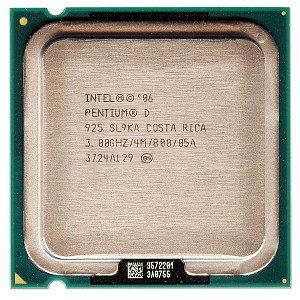
    Intel Pentium D 925 3.0GHz 800MHz 4MB-Cache Socket 775 CPU


    Intel's Pentium D 925 processor features a dual core design that offers exceptional functionality and performance for those who run multiple applications! Computer users can perform multiple tasks such as digital rendering and gaming while running a virus scan or other background tasks seamlessly! This Socket 775 CPU runs at 3 GHz on an800 MHz front side bus and a4 MB L2 Cache. For an outstanding computing experience for your desktop or workstation, upgrade to this Intel Pentium D 925 processor today!
    AMD Athlon64 FX-60 Dual Core Processor


    | CPU Processor Reviews, News | No Comments
    Dual core processors have already made their way into the high end wordstation and server market in a big way, but have been slower to crack into the consumer market and are often relegated to those looking to upgrade to very fancy machinery.

    One of the factors that comes into play is that much of the software available just doesn’t take advantage of this technology, whereas high performance systems have had it for a little while now.

    With the release of 64-bit windows and now video card manufacturers making their cards capable of utilising multi-core processors and hopefully soon, gaming software to support it dual-core processors are coming into their own, slowly, but surely.

    AMD and Intel take quite different routes to doing the dual-core processor thing, which can be read about in the article at pcstats. Both are bitter rivals, plugging away at their own technology to get as much as they can from their processors.

    AMD has introduced Cool ‘n’ Quiet technology which effectively clocks a processor down when it is not being used heavily, so its clock speeds are lower. When the computer starts using more resources the clock speeds and voltages are returned closer to their normal levels, until they reach normal levels somewhere near 100% system demand.

    The processor beats out the Pentium D 840 in all of the system tests that are performed and does so using less power, which is of great concern to those running hundreds of computers in a corporate environment, but probably less to most home users.

    64 bit operating system and software also made a big difference, allowing even faster speeds with this new technology.

    Check out the full article for all the details.


    CS123 Hardware and Software Installation


    CPU socket

    From Wikipedia, the free encyclopediaJump to: navigation, searchThe Socket 370 processor socket, a ZIF type PGA socketA CPU socket or CPU slot is a connector on a computer's motherboard that accepts a CPU and forms an electrical interface with it. As of 2007, most desktop and server computers, particularly those based on the Intel x86 architecture, include socketed processors.Most CPU-sockets interfaces are based on the pin grid array (PGA) architecture, in which short, stiff pins on the underside of the processor package mate with holes in the socket. To minimize the risk of bent pins, zero insertion force (ZIF) sockets allow the processor to be inserted without any resistance, then grip the pins firmly to ensure a reliable contact after a lever is flipped.As of 2007, several current and upcoming socket designs use land grid array (LGA) technology instead. In this design, it is the socket which contains pins. The pins contact pads or lands on the bottom of the processor package.In the late 1990s, many x86 processors fit into slots, rather than sockets. CPU slots are single-edged connectors similar to expansion slots, into which a PCB holding a processor is inserted. Slotted CPU packages offered two advantages: L2 cache memory could be upgraded by installing an additional chip onto the processor PCB, and processor insertion and removal was often easier. However, slotted packages require longer traces between the CPU and chipset, and therefore became unsuitable as clock speeds passed 500 MHz. Slots were abandoned with the introduction of AMD's Socket A and Intel's Socket 370.
    DualCor cPC [Mobile computer]01Mar06


    DualCor cPC [Mobile computer]01Mar06


    Mobile Professionals, Rejoice! Slightly smaller than a VHS tape, this mobile computer has two processors: a 400-megahertz mobile processor for light tasks such as Web surfing and a 1.5-gigahertz laptop chip that runs Windows XP for more intensive jobs like PowerPoint presentations. To conserve battery power, the individual processors don’t run when they’re not in use. Eight to 12 hours of battery life. DualCor cPC $1,500

    Christmas time, Apple launch iPhone nano

    Apple is about to launch a ‘nano’ version of the hugely successful iPhone. It is expected to be in the shops in time for Christmas.
    The product will be launched in the UK at up to £150 for pay-as-you-go customers by O2, the mobile phone group owned by Spain’s Telefonica. ‘This will be a big one,’ said an industry source.

    Intel Core i7 processors now Available to buy in the US


    The new Intel Core i7 processors are available on an Online computer shop (NewEgg) in U.S. for buying.These new technology processors from Intel will be available from 17 Nov. 2008 in U.S..No annnouncement regarding their availability in India has been made yet but they are expected soon.

    The first three processors in Intel Core i7 series will be:

    Intel Core i7 920 2.66GHz LGA 1366 Quad-Core Processor
    Intel Core i7 940 2.93GHz LGA 1366 Quad-Core Processor
    Intel Core i7 Extreme Edition 965 3.2GHz LGA 1366 Quad-Core Processor


    COMPUTER CONSULTANT EXPRESS

    Introduction

    Hello and welcome to the new corporate home page of Computer Consultant Express. CCE is a home based business to help the beginning or average computer user become more productive with their computer system. I believe in the "Teach a man to fish" principle. If I can fix your computer while teaching you at the same time then you will become more knowlegable in the process, rather than the "Fix it and leave" principle some people use. I charge a fair price for my services and I give you all the options at my disposal to help you make the right decisions. I can set up systems, small office or home networks and more. With over 20 years experience with computers and information systems I can help you get the most out of your investment. Please feel free to explore my services and products and if you are in need of something else please don't hesitiate to Contact me.
    Grids in IT history


    Information technology is constantly on the move. Many of the ideas behind grid computing are not new. For example:

    "Shared computing power" In the 1960s and 1970s, computing was dominated by huge mainframe computers that were shared by whole organizations.

    "Computing as a utility" In 1965, the developers of an operating system called Multics (an ancestor of Unix, which is an ancestor of Linux), first suggested the idea that access to computing resources could be like access to water, gas and electricity: something that you pays for according to the amount that you use.
    REINVENTING THE WHEEL?

    If these ideas are old ideas, is grid computing just a new way of "reinventing the wheel"? Perhaps, but each time the wheel is reinvented, it takes on a more powerful form, especially since computer processors, memories and networks improve at an exponential rates (ever heard of Moore's law?).

    The hardware behind grid computing typically improves by a factor of 100 every 10 years, enough to power all-new previously impossible IT solutions.

    1. A Core Duo Laptop With New Intel Integrated Graphics Technology


    HP's Pavilion DV1000T laptop computer comes with a 1.66 GHz Intel Core Duo CPU and the new Intel 945GM chipset with an integrated 950 GMA graphics processor. This is the first time MobilityGuru has looked at a mobile computer with the 950 Graphics Media Accelerator. How does the 950 GMA compare to earlier GMAs and to dedicated graphics processors?

    Overclocking the Intel Pentium D 805 processor
    Thursday, April 20th, 2006 | CPU Processor Reviews, News

    The Intel Pentium D processor provides a bottom of the range option for those looking for a dual core processor without the cost involved in getting many of them.

    This chip is fairly new to the market and mates two smithfield cores together, with a FSB of 533MHz, one L2 cache of 1MB each for the cores. Unlike its brothers and sisters in the 800 series of dual-core processors from Intel, which all run at 800MHz, this one runs slower at 533MHz, with a multiplier of 20 to get to a speed of 2.67GHz.

    In the review at legitreviews.com they managed to push the FSB up to 760MHz without any problems from the processor and loaded up Windows and ran their tests without any problems. The actual increase in performance did not quite match the rise in processor speeds, with the overall change being about a 29% in performance or so.

    The processor goes past the levels of the 840 processor and starts to come near the level set by the 840 Extreme Edition.

    There is a lot or praise for this chip on the site and the test scores go to show how much it can perform, and how much you can get for your money from the lowest priced dual-core processor around. With a decent motherboard for under a hundred bucks, you will be able to get a processor that is capable or running up to 3.8GHz with a little bit of overclocking.

    LINK